A wearable Raspberry Pi device using a computer vision model to detect oncoming cars and alert the user via LED strips and a buzzer — 1st Place, Synopsys Science Fair.
Growing up in a dense suburban environment, I noticed how easy it was for pedestrians — especially children, elderly individuals, or distracted walkers — to miss approaching vehicles in low-visibility situations. I wanted to explore whether a lightweight wearable device could use real-time computer vision to improve situational awareness and provide immediate alerts before a dangerous interaction occurred. The result was a wearable pedestrian safety system capable of detecting approaching vehicles and warning the user through visual and auditory feedback.
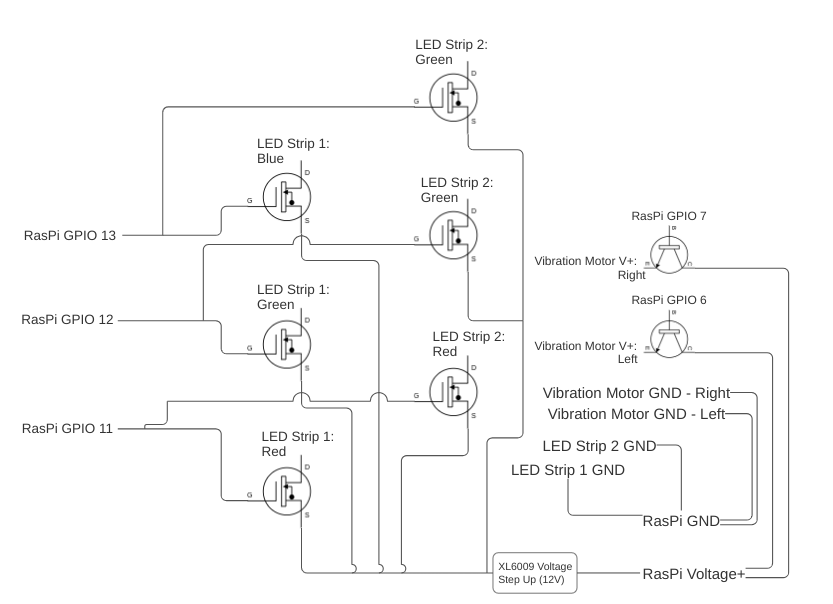
The system was built around a Raspberry Pi running a lightweight TensorFlow Lite object detection model trained to identify cars in real time using a forward-facing camera. OpenCV was used for image processing and frame optimization to maintain usable performance on edge hardware. When a vehicle was detected within a predefined threshold region, the Raspberry Pi communicated with an Arduino responsible for handling the alert subsystem. LED strips provided directional visual cues while a buzzer delivered an audible warning, allowing the device to function in noisy or low-light environments. The project required balancing model accuracy, latency, and power consumption while designing hardware compact enough to be wearable.
This project was presented at the Synopsys Science & Technology Championship, where it received 1st Place in Mechanical Engineering along with a special recognition award from IEEE. Beyond the competition itself, the experience introduced me to the full engineering process — from prototyping and debugging hardware to optimizing machine learning models for embedded systems. It also strengthened my interest in mechatronics, computer vision, and human-centered engineering design, especially in systems that bridge software intelligence with physical-world safety applications.